The Tang Xianzu Memorial Hall in Fuzhou is a comprehensive cultural venue built to commemorate Tang Xianzu, one of the world’s hundred great cultural figures and a master of Ming‑dynasty drama in China. It is also one of Jiangxi Province’s ten major memorial halls dedicated to historical luminaries.


Tang Xianzu: The Only Work That Truly Made Him Proud Was “The Peony Pavilion,” with Classic Exam Questions Included
Overview of This Article
Part 1 Re-reading “The Peony Pavilion” Part 2 Review of Actual Exam Questions
Part 3 Analysis of Classic Exam Questions
01
Rereading “The Peony Pavilion” (Excerpt)
“The Story of the Peony Pavilion” (commonly known as “The Peony Pavilion,” and also referred to as “A Dream of Rebirth” or “The Dream of the Peony Pavilion”) is a chuanqi play written by the Ming‑dynasty dramatist Tang Xianzu (September 24, 1550 – July 29, 1616), first published in the forty-fifth year of the Wanli era of the Ming dynasty (1617).
The play depicts Du Liniang, the daughter of a high-ranking official, who falls deeply in love with the scholar Liu Mengmei in her dreams. Moved by her passion, she resolves that “the living may die,” transforming into a spirit to seek her beloved in the mortal world—a tale of love between a human and a ghost. In the end, “the dead may live,” and she is finally united with Liu Mengmei in eternal bliss. The work is distinguished by its elegant prose and lyrical language, offering a rich and enduring reading experience.
Wenyan Youth has consistently emphasized that, for students preparing for the Chinese-language postgraduate entrance examination, reading the original texts and memorizing key passages and poems should be a continuous part of the entire review process. In the section on Ming and Qing dynasty drama, Tang Xianzu’s The Peony Pavilion stands out as a major focus. Below, Wenyan Youth invites you to revisit the seventh scene, “The Boudoir,” and the tenth scene, “A Dream in the Garden,” from The Peony Pavilion. The excerpts are drawn from Selected Works of Chinese Literature Through the Ages, edited by Zhu Dongrun (Shanghai Ancient Books Publishing House).

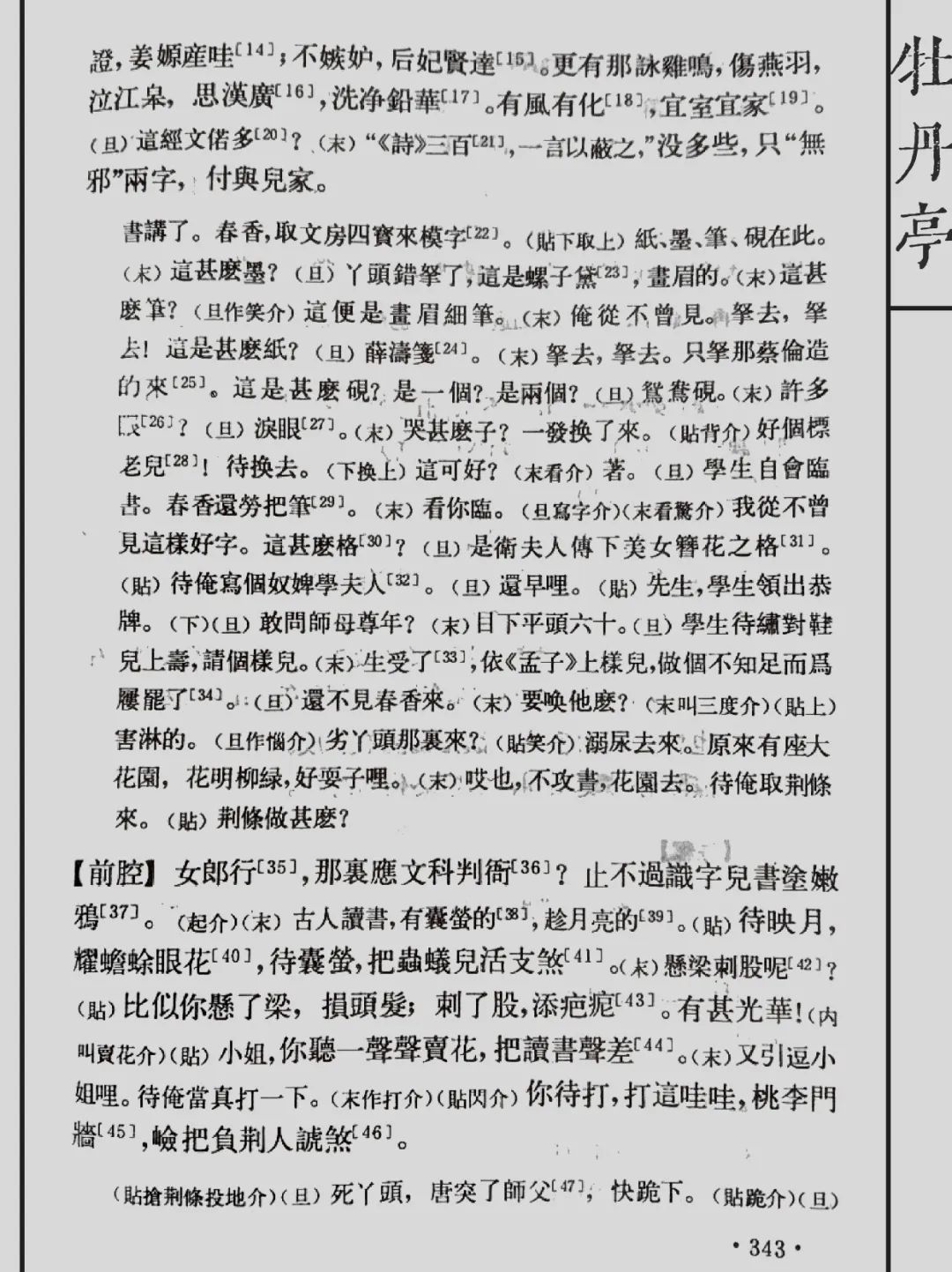
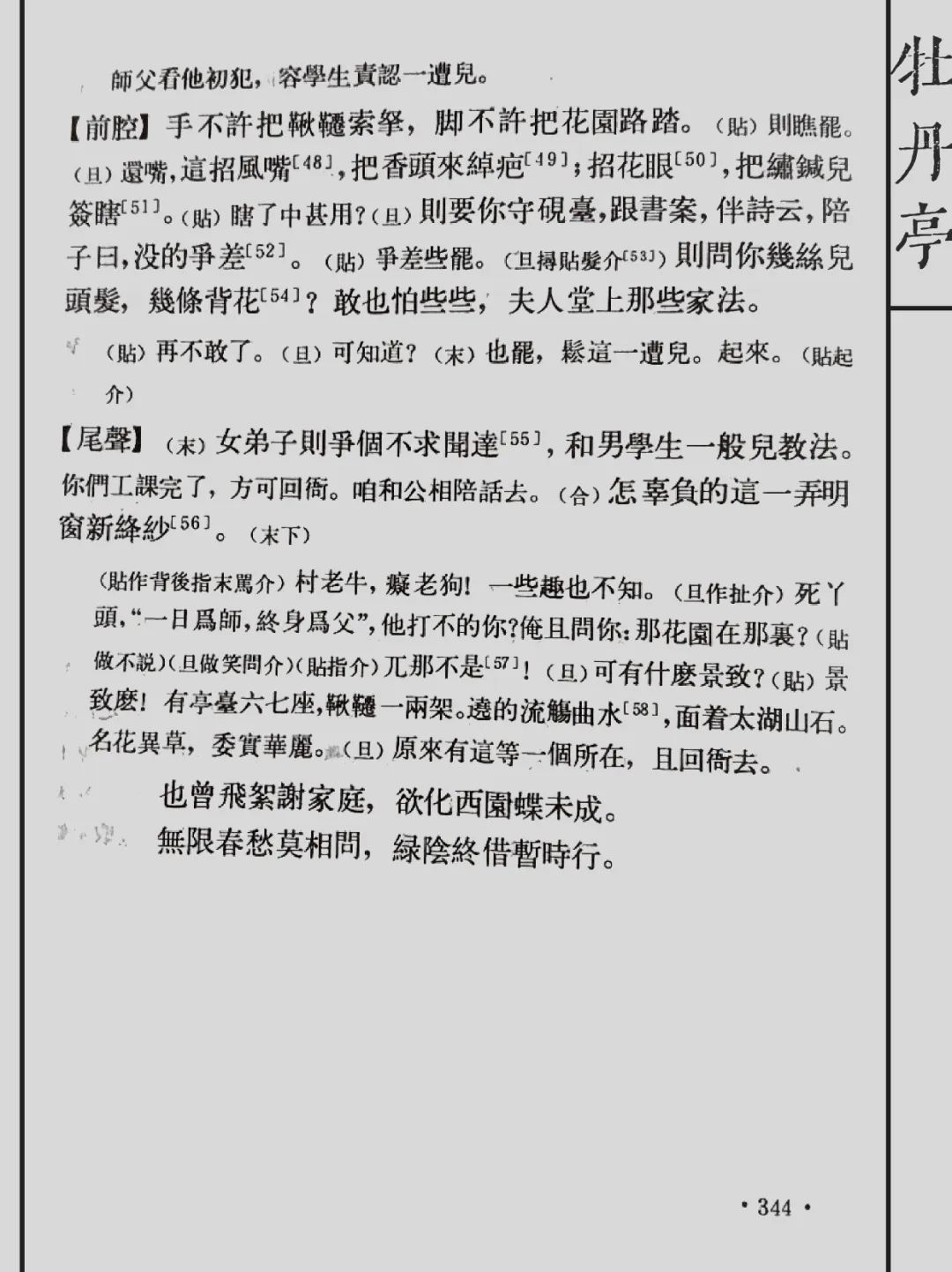
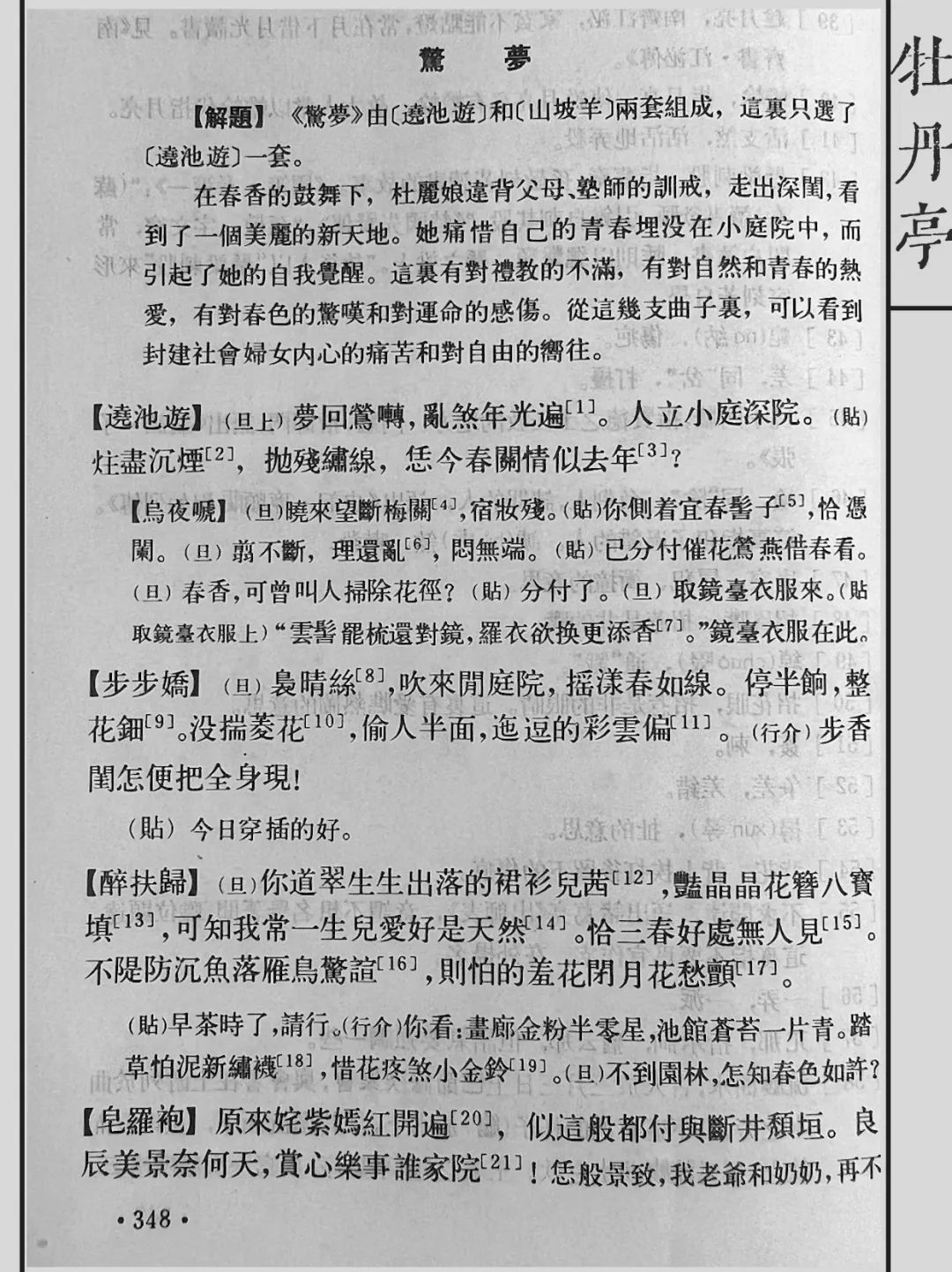
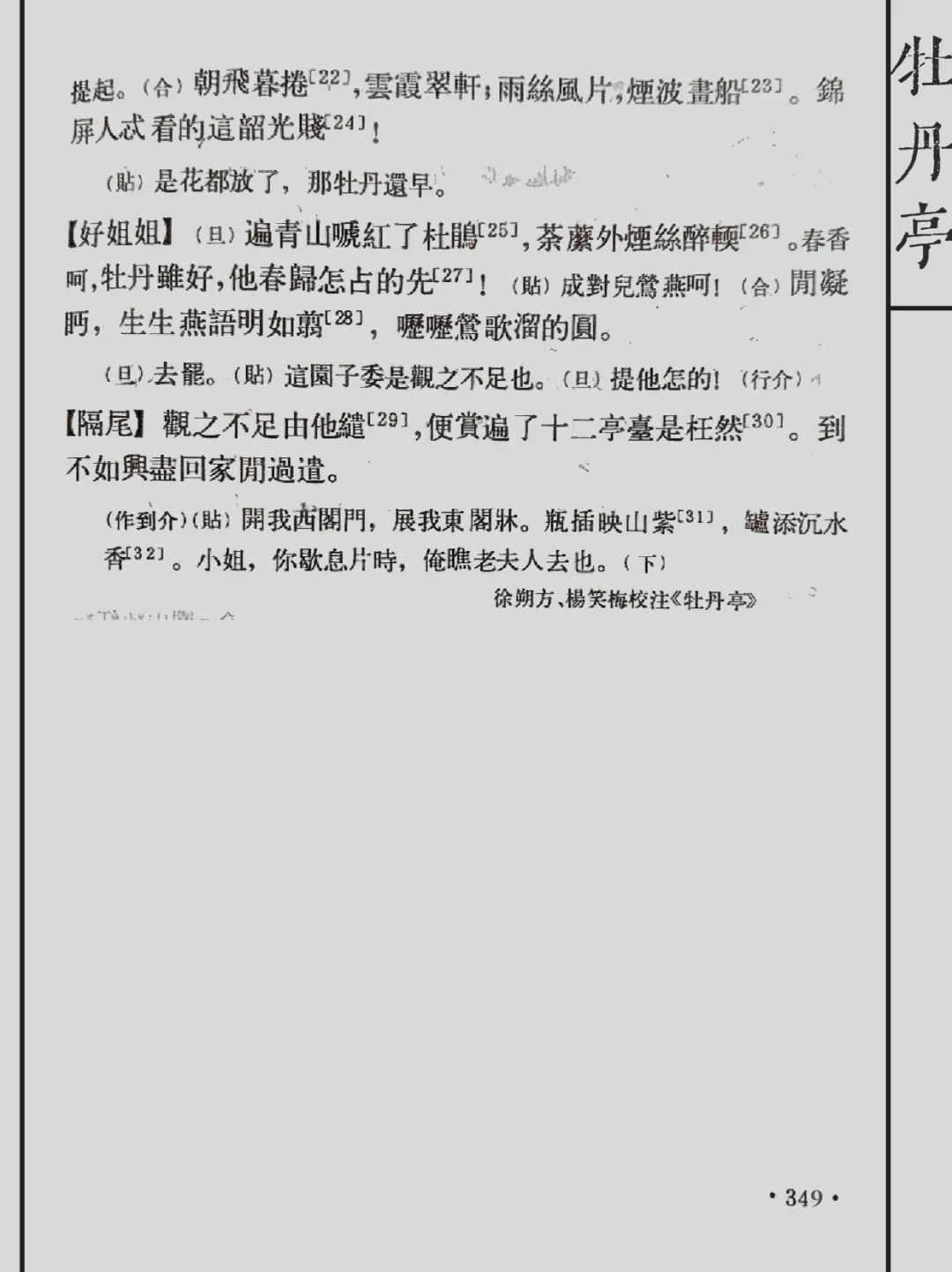
02
Key Concept Review and Sample Past Exam Questions
As a frequent high‑frequency topic, Tang Xianzu’s The Peony Pavilion and his theories on Chinese opera were examined in at least 11 institutions in 2023. Below, we list past exam questions from various perspectives. Using these sample questions as a framework, one can broadly cover the key examination points.
1. The Peony Pavilion
1. Briefly outline the thematic ideas and significance of “The Peony Pavilion.” (Northeast Normal University, 2016)
2. The content of “A Dream in the Garden” from “The Peony Pavilion.” (South China Normal University, 2007)
3. The Role of Dreams in “The Peony Pavilion.” (Shandong Normal University, 2018)
4. “The Peony Pavilion” embodies a conception of ultimate emotion, yet it does not transcend the view that “emotions arise from feeling but are brought to rest by propriety and righteousness.” (Shanghai Normal University, 2023)
5. Evaluate the character of Du Liniang in “The Peony Pavilion” by drawing on the image of Cui Yingying from “The West Chamber.” (Central South University, 2023)
6. Discuss the cultural and cautionary significance of "The Peony Pavilion." (Zhejiang Normal University, 2023)
2. The Theory of Opera and the Controversy Between Tang and Shen
1. Analyze Tang Xianzu’s literary principles in light of “The Peony Pavilion.” (Southeast University, 2023)
2. Please list Tang Xianzu’s representative works and, in conjunction with these works, discuss his literary and artistic thought. (Beijing Foreign Studies University, 2023)
3. Briefly outline Tang Xianzu’s theory of “meaning, interest, spirit, and color.” (Soochow University, 2003)
4. Based on the creation of “The Peony Pavilion,” discuss the conflict between the Linchuan School and the Wujiang School. (Southwest University, 2023)
5. In light of the development of Ming‑dynasty opera, discuss the focal points and underlying significance of the “Tang–Shen Controversy.” (Sun Yat-sen University, 2023)
6. The Controversy Between Tang and Shen (Fujian Fan Da, 2023)
7. Discuss your understanding and interpretation of the “Tang–Shen Controversy.” (Nanjing Normal University, 2017)
3. Other Works
Definition of the term:
The Four Dreams of Linchuan / The Four Dreams of Yumingtang (Beijing Language and Culture University, South China Normal University, Inner Mongolia University, Northeast Normal University, Northwest University, 2023)
03
Analysis of Classic Exam Questions
1. Discuss the cultural significance of “The Peony Pavilion.” (Shandong University, 2021)
A Youthful Analysis by the Institute of Literature: “The Peony Pavilion” is a dramatic work penned by the Ming‑dynasty playwright Tang Xianzu. Through Du Liniang’s life‑and‑death struggle in pursuit of an ideal love and marriage, it passionately celebrates the rejection of feudal propriety, the yearning for a free and happy love, and the fervent aspiration for personal liberation.
First, in its critique of feudal propriety and morality, The Peony Pavilion opposes “reason” with “emotion,” rejecting the orthodox Cheng–Zhu Neo-Confucianism while affirming and championing human freedom and emotional value. The author elevates “emotion” to an exalted, supreme position, using the character Du Liniang to articulate a sharp rebuke of Cheng–Zhu orthodoxy: driven by love, she dreams; through her dream, she falls ill; from illness, she dies; yet, revived by love, she boldly speaks out in the imperial palace to defend her passion. Ultimately, moved by her sincerity, the emperor grants her marriage, and her union with Liu Mengmei stands as a daring challenge to traditional ritual and moral constraints.
Secondly, in its portrayal of human desires, The Peony Pavilion breaks with asceticism and champions the liberation of individuality. Centering on Du Liniang, it depicts, from a female perspective, the constraints imposed on Ming‑dynasty women by feudal Confucian norms, articulating their emotional anguish as well as their yearning for and pursuit of sexuality—thus revealing the author’s sympathy for and respect toward women. By integrating love with humanity’s natural instincts and legitimate needs for survival, the author elevates “qing” to a realm that transcends life and death.
Beneath the classic “talented scholar and beautiful lady” love story of The Peony Pavilion lies Tang Xianzu’s political ideals. Du Liniang’s poignant lament—“Such flowers and grasses are loved by all, yet life and death follow one’s every wish; still, even with aching heart and bitter sorrow, none loves me”—and her sense of fate, born of being “unable to secure an early, auspicious match,” of time slipping away “like a crack in the sun,” and of her own “beauty like blossoms” yet “life as fleeting as a single leaf”—all express, in essence, Tang Xianzu’s political melancholy over his unfulfilled talents and the wasted years of his youth. Du Liniang’s act of “rebeling against reason with emotion” reflects Tang Xianzu’s defiance of the traditional Confucian doctrine of “loyalty to the ruler”; through art, he seeks to console his frustrated, brooding Confucian commitment to engaging with the world. Indeed, the contradictions within Du Liniang’s character mirror the author’s own bewilderment and anguish as he struggles between old and new ideas: on the one hand, he longs to follow the traditional Confucian path of active participation in public life; on the other, he yearns for the spontaneity of Daoist sages like Laozi and Zhuangzi, or of thinkers like Li Zhi, who would act according to their inner impulses and remain free from the constraints of worldly conventions.
In sum, the genuine emotions—natural, profound, and brimming with extraordinary vitality—are the central motif that Tang Xianzu exalts in The Peony Pavilion. Beneath this theme of “supreme sincerity,” however, lie multiple layers of cultural significance. Within the tender yet soaring melody of a hymn to “love’s defiance of reason,” there also lurks Tang Xianzu’s subtle, allusive artistry—through which he articulates a lucid awareness of his own political ideals.
2. Based on the creation of “The Peony Pavilion,” discuss the conflict between the Linchuan School and the Wujiang School. (Southwest University, 2023)
An analysis by young scholars of the Institute of Literature: The main points of divergence between the Wujiang School and the Linchuan School can be summarized as follows:
Overall, Shen Jing’s dramatic works exhibit a rather conservative ideological orientation, with a pronounced emphasis on upholding feudal ethics and morality. By contrast, Tang Xianzu, the founder of the Linchuan School, vigorously championed the liberation of “emotion,” asserting that those who live for love may die, and those who die may live; his masterpiece, The Peony Pavilion, stands as the principal embodiment of this doctrine.
The second issue is whether to prioritize ornate rhetoric or natural simplicity. The Linchuan School placed great emphasis on literary flair, whereas the Wujiang School advocated for a plain, unadorned style, opposing excessive use of elaborate diction and parallelism and stressing the importance of language that is both accessible and spontaneous. Yet, with the exception of a handful of plays such as “The Tale of Righteous Chivalry,” Shen Jing himself never fully succeeded in achieving this ideal of simplicity, while Tang Xianzu’s diction tended toward a more refined, elegant style.
Third is the “theory of prosody and rhythm,” which reflects a differing view on the rules of musical composition. The Wujiang School emphasizes “adhering to the tune and following the vocal style,” asserting that metrical norms take precedence and maintaining that, in opera, the primary concern is whether the work conforms to these rules—so much so that lyrical expression may be sacrificed in the name of strict adherence. Thus, it is said: “Better to conform to the meter even if the result is not polished; let the text fail to form complete sentences, yet when sung it will at least fit the melody—this, indeed, is the true artistry of the song.” This represents the most pronounced divergence within Shen and Tang’s theories of opera. In his set of pieces titled “Er Lang Shen,” Shen Jing declares in his essay “On Opera by Master Ci Yin”: “When seeking to fashion new melodies, do not stray from established forms! Though called ‘Music of the Court,’ one must ensure that both meter and tune are in harmony. Better that contemporary listeners fail to appreciate it than that they strain their throats or distort their voices. One cannot claim to possess talent simply because one is gifted; the more talented one is, the more carefully one ought to weigh and refine one’s work… Even if the words flow from a brocade‑like heart and the singing seems to linger around the rafters, if it does not accord with the laws of sound and rhythm, it can hardly merit praise.” Of course, paying close attention to prosody and rhythm is entirely proper; yet to the point where one would willingly sacrifice meaning for the sake of strict conformity—and even to proclaim, as Lü Tiancheng does in his “Qu Pin,” “Better to conform to the meter even if the result is not polished; let the text fail to form complete sentences, yet when sung it will at least fit the melody—this, indeed, is the true artistry of the song”—that goes too far. Even Shen Jing himself could scarcely achieve perfect precision in every single word; Feng Menglong and others repeatedly pointed out his lapses in matters of musical meter.
3. Discuss the artistic achievements of Tang Xianzu’s opera “The Peony Pavilion.” (Wuhan University, 2021)
A Youthful Analysis by the Institute of Literature: In terms of artistry, “The Peony Pavilion” displays the dazzling hues of Romanticism—its seamless fusion of the fantastical and the real, its fervent pursuit of subjective spirit, its richly lyrical scenes, and its elegant, opulent musical texts—all of which epitomize its quintessential Romantic style.
First and foremost, this is manifested in the work’s imaginative artistic conception. The play’s unreal subject matter and its guiding principle—that what is “logically impossible” yet “emotionally inevitable”—necessarily call for artistic techniques steeped in idealism. In terms of plot structure, the drama brims with bizarre, dramatic twists and turns, such as the episodes of “A Startling Dream,” “Judgment in the Underworld,” “Wandering of the Soul,” and “Revival,” all of which are both absurd and extraordinary. It is precisely this series of fantastical artistic ideas that forms the framework and backbone of the play, playing a crucial role in conveying its central theme. Although Tang Xianzu pushes his characters and narratives to the very limits of unreality, he occasionally grounds them in palpable reality—for instance, Du Liniang, upon returning to life, must abide by the rites and conventions of the mortal world, subjected to various constraints beyond her control. This interplay of the imaginary and the concrete seamlessly fuses idealism with everyday reality.
Secondly, this is manifested in a series of lyrical scenes that convey the protagonist’s fervent aspirations, externalizing her subjective spirit and, on that basis, driving the dramatic conflict to ever‑greater intensity. The central focus of The Peony Pavilion lies in portraying Du Liniang’s repressed emotions, the richness of her inner world, and the awakening of her youth. With astonishing literary power, Tang Xianzu lays bare Du Liniang’s inner life, exposing the hidden depths of a soul profoundly at odds with her social status and the circumstances in which she finds herself.
Furthermore, the entire play is suffused with a rich lyrical‑poetic quality, and many of its arias and lyrics seamlessly blend lyricism, scenic description, and character development. Take “Startled Dream,” for instance: it evokes nature while subtly alluding to the human condition, its elegant and graceful language brimming with a deeply moving and poignant mood. This scene marks Du Liniang’s pivotal transition from joy to sorrow, from sighs to resentment; rendered with poignant tenderness and an intimate fusion of emotion and setting, it allows the reader to sense Du Liniang’s profound affection without compromising her status as a young lady of noble birth.
Finally, “The Peony Pavilion” is a composite drama that seamlessly blends elements of tragedy, comedy, farce, and buffoonery. To claim the right to love, one must pay with one’s life—this is not only Du Liniang’s personal youthful tragedy but also a broader tragedy of family and society; scenes such as “A Sorrowful Outburst” and “A Soul’s Wanderings” are profoundly mournful and heartrending, while others like “The Girls’ Tutorial” brim with comic vitality. This dramatic style, in which sorrow and joy intermingle and mutually illuminate one another, is a vivid embodiment of the romantic spirit that defines Chinese opera.
-END-
Editor: Deng Chao | Source: Wenyan Youth
Submissions are welcome: 363036353@qq.com
National Level-3 Museum
Jiangxi Province Patriotic Education Base
Jiangxi Province Primary and Secondary School Research-and-Practice Education Base
China Overseas Chinese International Cultural Exchange Base
On-site Teaching Site of the Jinggangshan Cadre Academy of China
Chinese Qu Culture Education Base


Copyright © Tang Xianzu Memorial Hall of Fuzhou City (Fuzhou Tang Xianzu Culture and Art Center) Technical Support:China Enterprise Dynamics-Nanchangvertical strokeSEO
